EvaluationAgency OperationsSimone Figueira5 min read
The Excel Trap: Why Insurance Agents Will Bleed Clients and Commissions This Open Enrollment
Every minute your producers spend copy-pasting client data into spreadsheets, competitors with automated CRMs are locking in enrollments. Here is why Excel is fatal for OEP 2027.
Open Enrollment is the most intense, high-stakes revenue window of the entire insurance calendar. In a matter of ten weeks, agencies generate over seventy percent of their annual policy volume. Yet heading into Open Enrollment 2027, an alarming number of agency owners and independent producers are still running their entire operation on Microsoft Excel, Google Sheets, or makeshift shared workbooks.
Make no mistake: spreadsheets were engineered for static financial modeling and row-and-column accounting in the 1980s. They were never designed to orchestrate live phone transfers, enforce speed-to-lead under two minutes, track Data Matching Issues (DMIs), or protect your Agent of Record status against aggressive regulatory changes.
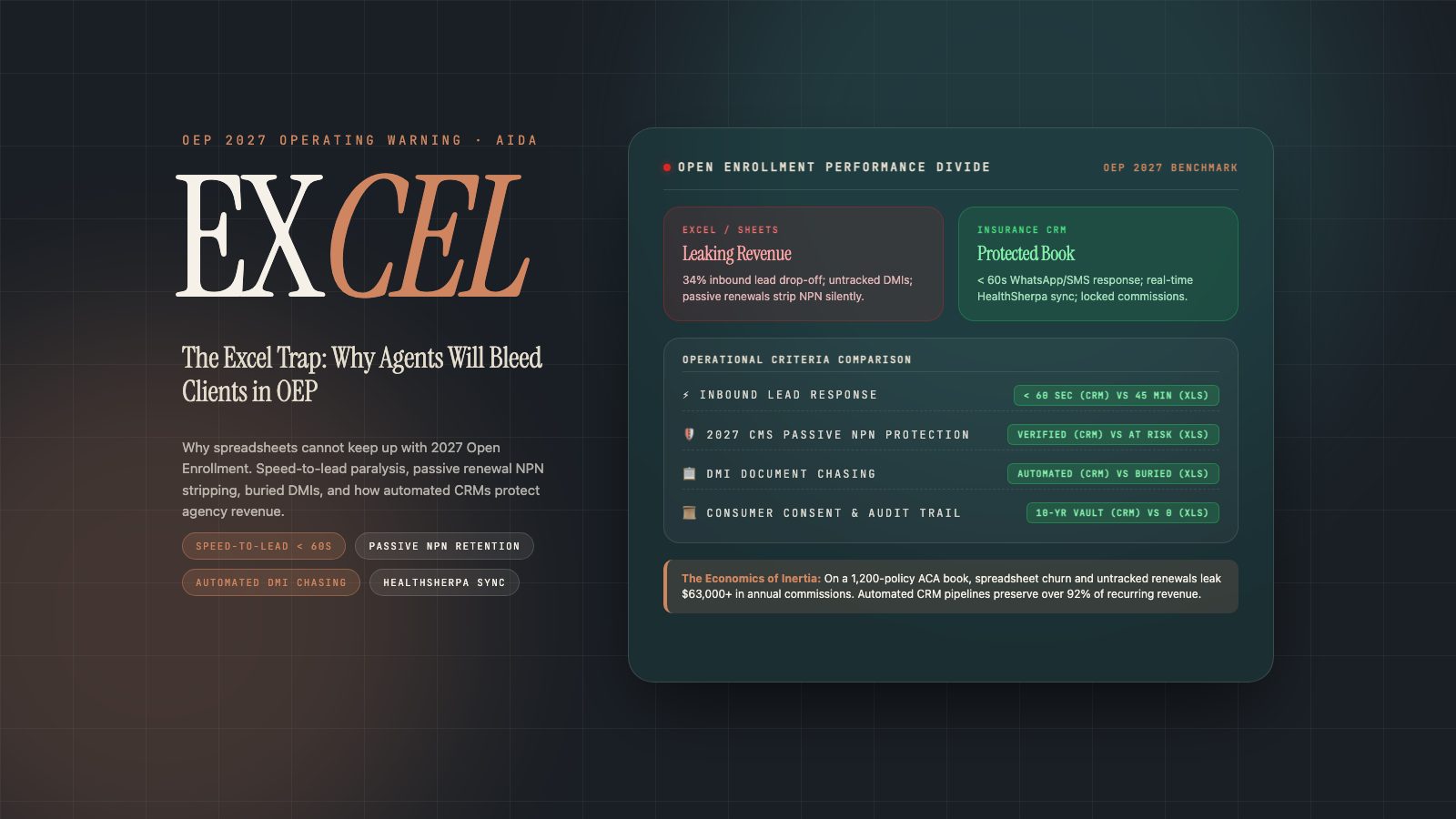
In operational audits conducted across insurance agencies migrating to CRMDAY One, brokerages managing Open Enrollment leads on spreadsheets lost an average of 34% of inbound leads due to follow-up delays exceeding fifteen minutes. Furthermore, their client retention rate dropped by 27% compared to agencies operating automated CRM renewal workflows.
Where the Revenue Leaks: The 4 Fatal Flaws of Spreadsheets in OEP
When call volume spikes and leads pour in from digital campaigns, aggregators, and referrals, spreadsheet workflows collapse under four critical operational failure points:
- 01Speed-to-Lead Paralysis: If an inbound lead fills out a form, a spreadsheet sends no instant push alert, triggers no automatic two-way SMS, and initiates no round-robin dialer queue. By the time an agent manually copies row 114 to call the consumer, a competitor with an automated CRM has already quoted the plan and captured consent.
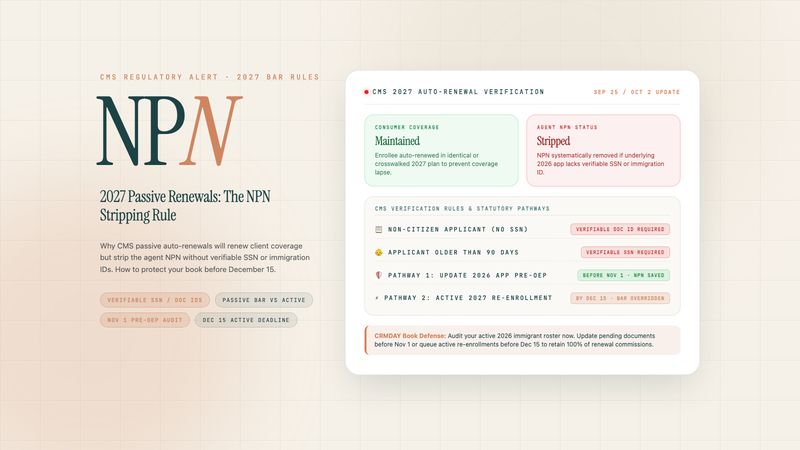
- 02The Silent Churn of Passive Renewals: Under CMS's 2027 auto-renewal rules, passive re-enrollments lacking verified SSNs or immigration document IDs will automatically strip the agent NPN. Spreadsheets cannot cross-reference marketplace data or alert you to unverified dependents before the December 15 deadline.
- 03Buried Document Deadlines and DMIs: HealthCare.gov gives enrollees strict 90-day cure windows to resolve income or citizenship inconsistencies. In a spreadsheet of two thousand rows, missing paystubs and expired work permits get buried until coverage terminates and commissions are clawed back.
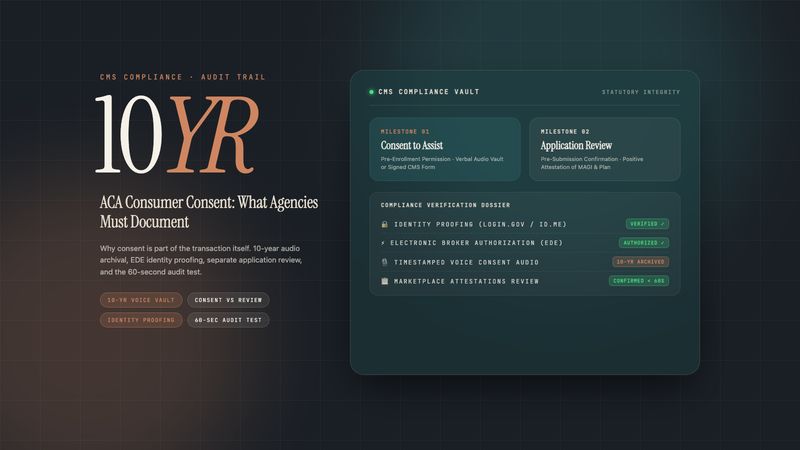
- 04Zero Compliance Audit Trail: Spreadsheets cannot capture cryptographically verifiable consumer consent, timestamped electronic application reviews, or ten-year audio recordings. If CMS or a carrier audits your agency, an Excel row is legally indefensible.
Spreadsheets vs. Insurance CRM: The Open Enrollment Battlefield
Comparing how a traditional spreadsheet brokerage and an automated CRM brokerage operate during peak season reveals a massive performance divide:
| Operational Capability | Spreadsheet Operations (Excel / Sheets) | Dedicated Insurance CRM (CRMDAY One) |
|---|---|---|
| Speed-to-Lead Response Time | 15 to 120 minutes (manual copy-paste from webhooks or emails) | Under 60 seconds via automated WhatsApp, SMS, and instant dialer distribution |
| Lead Routing & Agent Collision | High collision; agents overwrite cells, double-call leads, or drop prospects | Automated round-robin distribution with agent concurrency locking |
| HealthSherpa & Carrier Sync | None; manual end-of-day CSV exports and reconciliation headaches | Real-time webhook synchronization of applications, policies, and statuses |
| DMI & Document Chasing | Manual review of color-coded cells; high cancellation rate | Automated multi-touch client reminders with secure upload portals |
| NPN Safeguard & Renewals | Blind trust in passive renewal; high risk of silent NPN stripping | Proactive renewal triage queues identifying unverified accounts before deadlines |
“Excel is where valuable insurance leads go to die. During Open Enrollment, every second of latency is commission handed directly to your fastest competitor.”
The Economics of Inertia: What Sticking with Excel Actually Costs
Many agency owners hesitate to adopt a modern insurance platform because they view CRM as a software expense. In reality, staying on spreadsheets is the single most expensive operational choice an agency can make.
Consider an agency servicing a modest portfolio of 1,200 ACA policies. If 22% of those accounts drop off due to unattended passive renewal issues, unworked crosswalk plans, or missed document notices, the agency loses 264 policies. At an average carrier renewal commission of $20 to $24 per member per month, that represents over $63,000 to $76,000 in recurring revenue lost every single year.
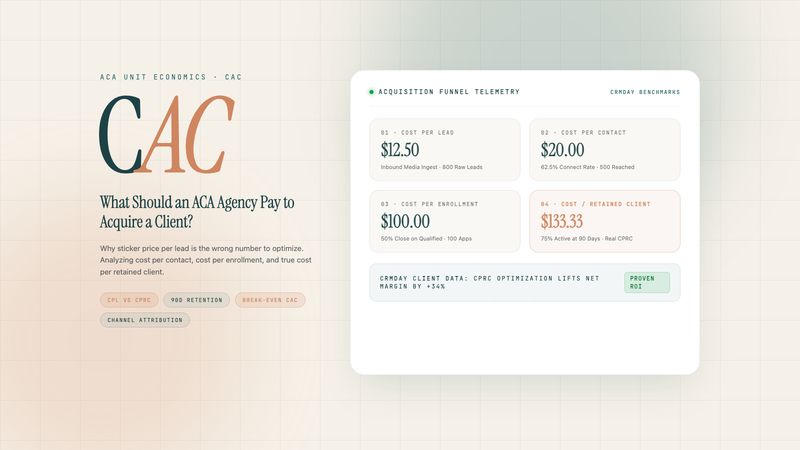
On the acquisition front, an agency buying 500 leads during Open Enrollment at $35 per lead invests $17,500. A spreadsheet conversion rate of 8% yields 40 policies. A modern CRM workflow converting at 16% through instant multichannel follow-up yields 80 policies: doubling production without spending a single additional dollar on marketing.
Ready to stop leaking leads and protect your renewal revenue this season? Discover CRMDAY Insurance CRM
The High-Performance Alternative: The Automated OEP Engine
When an agency replaces spreadsheets with an operating engine purpose-built for health insurance, producers stop being data entry clerks and become high-volume closing machines:
- Instant Lead Engagement: Inbound prospects receive a branded WhatsApp and SMS acknowledgment within thirty seconds, establishing trust before competitor call centers reach them.
- Single-Pane Customer Dossiers: Agents view household demographics, income projections, HealthSherpa application status, call recordings, and consent records on a unified screen.
- Automated Chasing Pipelines: Clients with outstanding proof of income or immigration verifications receive automated scheduled prompts until documents are safely uploaded.
- Comprehensive Renewal Telemetry: Agency leaders monitor live dashboards showing exactly which policies are bound, which are pending active enrollment, and which need emergency outreach.
The 30-Day Transition Playbook: Escaping Excel Before November 1
Migrating from spreadsheets to a high-octane CRM does not require months of downtime. Follow this three-phase sprint to prepare your agency before the market opens:
Phase 1: Roster Consolidation & Data Hygiene
Export all historical client rosters from carrier portals and HealthSherpa. Clean duplicate records, validate phone numbers, and map custom immigration and household fields into your CRM.
Phase 2: Speed-to-Lead & Multichannel Trigger Setup
Connect digital ad forms, aggregator webhooks, and phone lines. Configure automated instant SMS/WhatsApp replies and round-robin distribution to active producers.
Phase 3: Active Renewal Queuing & Dry Run
Segment your existing book into active renewal priority tiers. Train agents on one-click HealthSherpa EDE quoting, consent documentation, and document tracking workflows.
Open Enrollment 2027 will not reward agencies that work harder in spreadsheets. It will reward agencies that execute faster, follow up automatically, and protect their renewal book with ruthless precision. If you are still running on Excel when November 1 arrives, you are voluntarily surrendering market share to competitors who upgraded.
Next step
Test it with your own workflows.
Start a free trial with a sample of your book, or bring your questions to a conversation with our team.
Sources
- HealthCare.gov — Dates and deadlines (opens in a new tab)
- CMS — Consumer consent and application review requirements (FAQ) (opens in a new tab)
- HealthSherpa Help Center — 2027 Marketplace Renewal Guidance & CMS Verification (Oct. 2026) (opens in a new tab)
- FCC — Stop unwanted robocalls and texts (opens in a new tab)
This article is for information only and reflects public information as of its publication date. It is not legal or tax advice. Confirm current rules with CMS, your state exchange and your carriers.